Kinase Knowledgebase (KKB)

The Kinase Knowledgebase (KKB) is Eidogen-Sertanty's database of kinase structure-activity and chemical synthesis data. The KKB represents the first gene-family wide implementation of our proprietary web-based technology for the capture, curation, and display of biological activity and chemical synthesis data from scientific literature and patents.
Kinase Knowledgebase

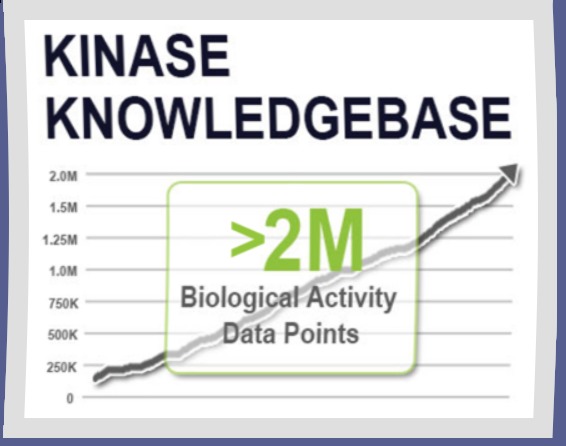
Currently the Kinase Knowledgebase Q2 2026 Release includes the following data:

  • Journal articles and patents: 10,326
  • Number of Biological Activity Data Points: 3,336,903
  • Number of unique kinase molecules with annotated assay data: 509,691
  • Number of all unique kinase molecules from patents and articles (with or without bio-activity data): 854,437
  • Number of unique kinase targets with assay data: 579
  • Number of annotated assay protocols: 105,916
  • Machine-learning models built from this release’s SAR: activity classifiers across 392 kinase targets, median ROC-AUC 0.91 (0.95 for well-studied kinases) – view model performance report

Drawing tool powered by Ketcher - Open Source Molecule Editor

Human Kinome Tree Views

Data Quality & Applications

For a more comprehensive list of all SAR data points for each target, please contact us.

Computational scientists will find Eidogen-Sertanty's knowledgebase to be an exceptional source for high quality training sets to build predictive QSAR models. All SAR data undergoes rigorous quality control. Every data point is associated with detailed bio assay protocols and is classified by:

Where a KKB compound is also a ligand in a Protein Data Bank kinase structure, our contact maps draw what that compound is doing in the site, and bound is not necessarily potent shows how far measured potency ranges among ligands solved in the same pocket. The maps draw: hydrogen bonds with a real donor to hydrogen to acceptor angle, halogen bonds, salt bridges, pi stacking, cation to pi and metal coordination, every one of them measured from the deposited coordinates and shown beside the KKB activity for that same pair.

We select the most relevant data such as in vitro enzyme activity data - in particular IC50 values - for the development of QSAR models (ePotency and eSelectivity), and cell-based activity and toxicity data for the development of advanced activity models (eADME and eTox).

Our curation process also captures chemical synthesis steps for those kinase inhibitors with detailed experimental procedures. Chemistry information is organized by protocols of generic reaction sequences incorporating synthetically feasible reagents that are reported in the context of the claims of a patent. This not only generates all specific examples from a patent, but also a comprehensive ensemble of structures - the patent space - that can possibly be made by the reported synthetic methodology, and which are potentially relevant within the biological activity class. Synthetic pathways leading to these molecules are structurally linked to the biological information.

Arrow

KKB Downloads


Kinase Knowledgebase content development Using Receptor-Site and Protein Structural Similarity to Generate New Matter Ideas Surveying ligand- and target-based similarities within the Kinome Kinome-wide Activity Models from Diverse High-Quality Datasets

SMILES String

Loading...

Value to Drug Discovery

The knowledgebase is designed to support medicinal chemists during all project stages of drug discovery. We work closely with our clients to ensure that they receive all the relevant information around their targets and anti-targets.

At the start of a lead discovery project, the Kinase Knowledgebase provides an overview of published knowledge and patents around kinase targets of therapeutic importance, enabling a detailed understanding of the knowledge space around the target of interest and the relevant anti-targets. The presentation of inhibitor structural data makes it easy to group known inhibitors in scaffold groups and lay out a project plan around patentable chemotypes.

In the lead discovery and optimization phase of a project, the knowledgebase helps to prioritize compounds for synthesis or purchase based on their predicted properties. Based on the high quality content we have captured, we have developed nearly 50 kinase-specific eScreen® modules useful for potency and selectivity prediction, lead optimization and scaffold jumping.

Applications

Data Access

The Kinase Knowledgebase is designed such that it can be used by every scientist in the drug discovery team, even those without special training in the computational sciences. The KKB is available in a variety of data formats for direct access and integration into in-house databases.

To find out more about licensing terms and arrange a product demonstration, please
contact us

Searching Kinase Knowledgebase (KKB)...

Please wait while we process your request...