
Drug Discovery Software & AI Solutions
Leading provider of pharmaceutical research tools
Our Products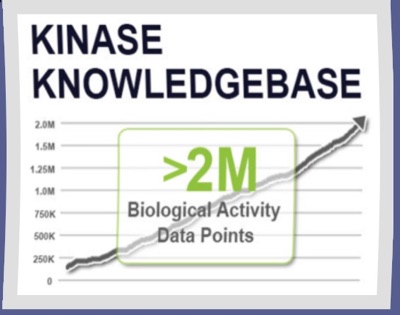
Our Solutions

Family Foundation Model New!
The broad instrument. Two separately fitted models over one roster spanning 34 protein families. One says which of two compounds a target prefers, the other says which of two targets from different families a compound prefers. Trained on ChEMBL 37 alone, so both are freely downloadable. 0.71 on 65,725 held-out comparisons over 2,079 targets, and 0.75 on 8,689 over 1,879 targets. The GPCR and kinase models below are family deep dives beside it.
Explore the model →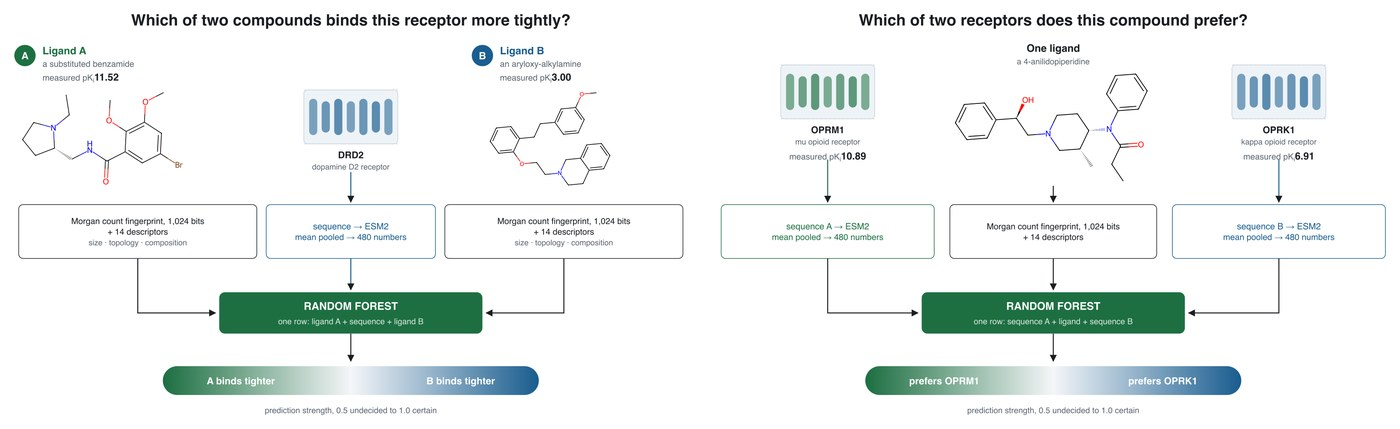
GPCR Foundation Model New!
Two models over G protein-coupled receptors, one question each. Give the first a target sequence and two compounds and it ranks which is more potent. Give the second one compound and two targets and it says which the compound prefers. No structure or docking needed. A deep dive into one family, on ChEMBL together with Eidogen-curated GPCR data, 389,013 measurements across 284 targets, and a measured accuracy published for every target with held-out data.
Explore the model →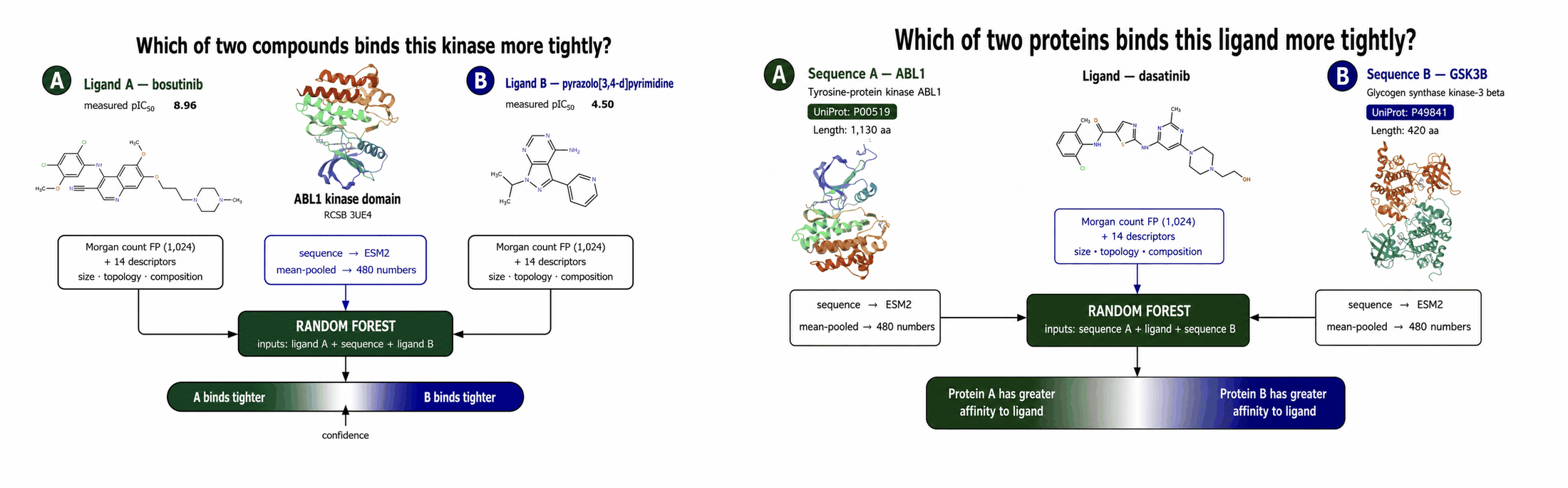
Kinase Foundation Model New!
Two models, one question each. Give the first a kinase sequence and two compounds and it ranks which is more potent. Give the second one compound and two kinases and it says which the compound prefers, the selectivity question. No structure or docking needed. A deep dive into one family: primary measurements from the Eidogen-Sertanty Kinase Knowledgebase, with ChEMBL used to cross-validate rather than to train.
Explore the model →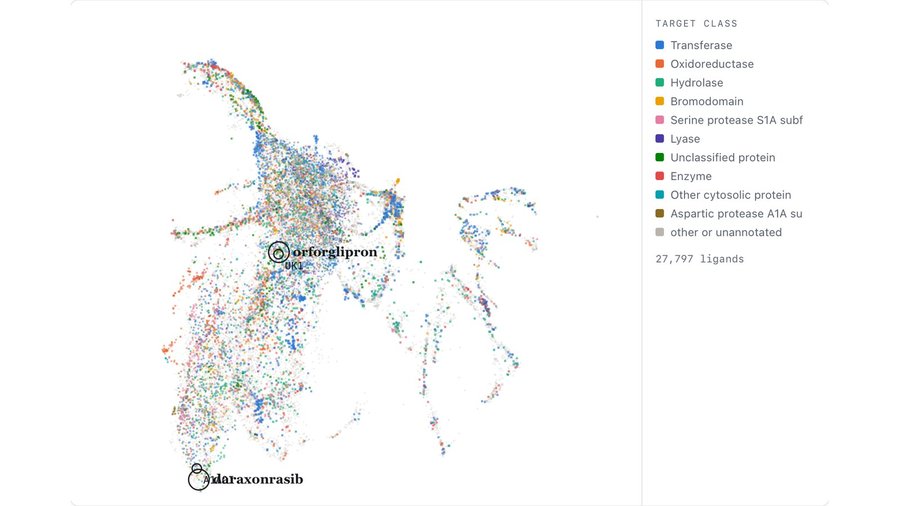
Reverse Screen New!
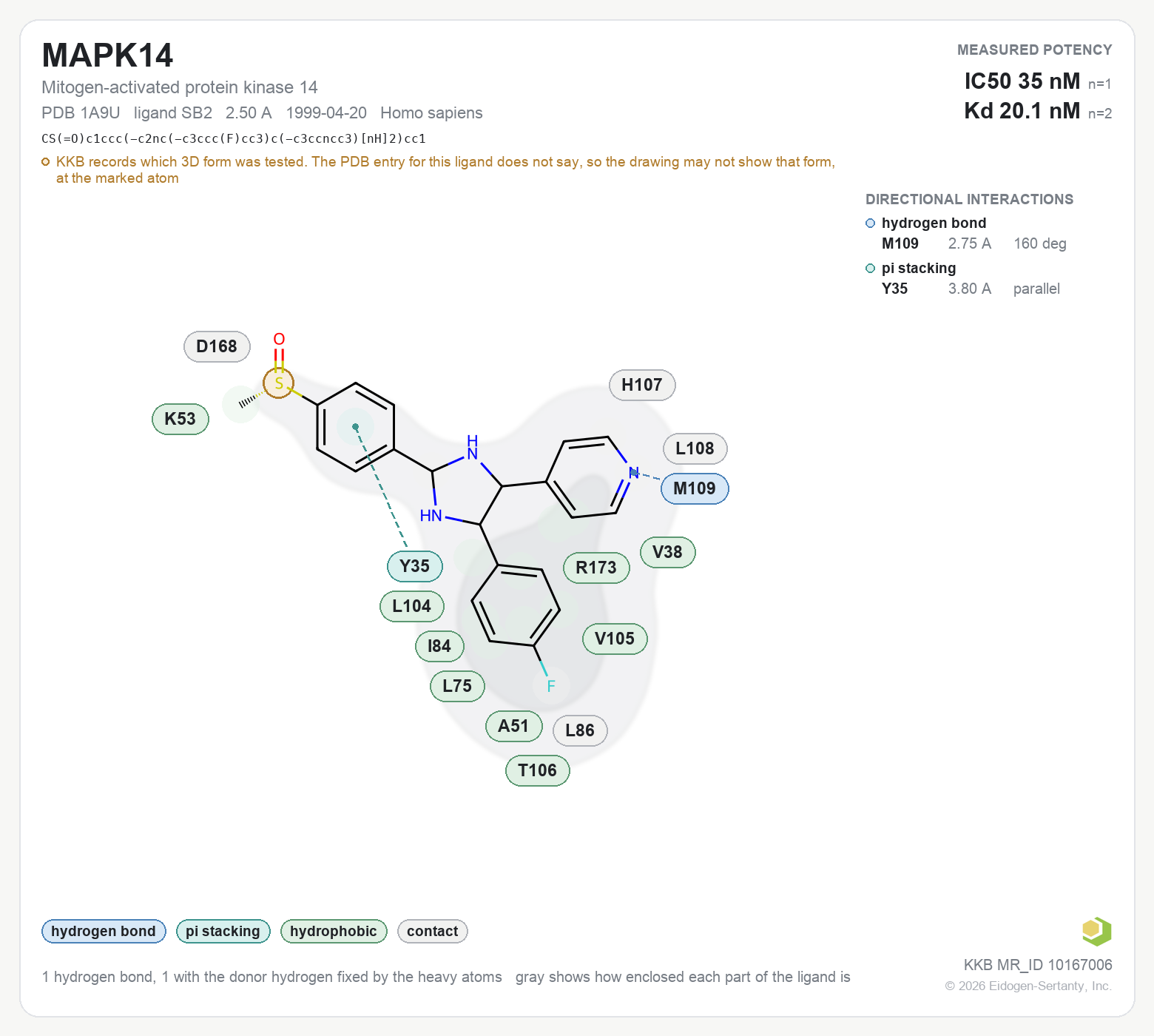
Given a molecule, the proteins it might interact with. Every co-crystal ligand in the Protein Data Bank is indexed by the pharmacophore fingerprint it presents, so a query returns candidate targets in 52 milliseconds instead of the 40.5 hours it takes to dock into every site. AutoDock Vina then docks only into what retrieval returns.
Screening orforglipron returns matrix metalloproteinase 9 at rank 5 of 48, through the deposited ligand E40 in 4WZV at a pharmacophore similarity of 0.803, two molecules that share no scaffold. Docking into that site gives a top pose at −12.1 kcal/mol.
Try Reverse Screen →
Kinase Knowledgebase (KKB)
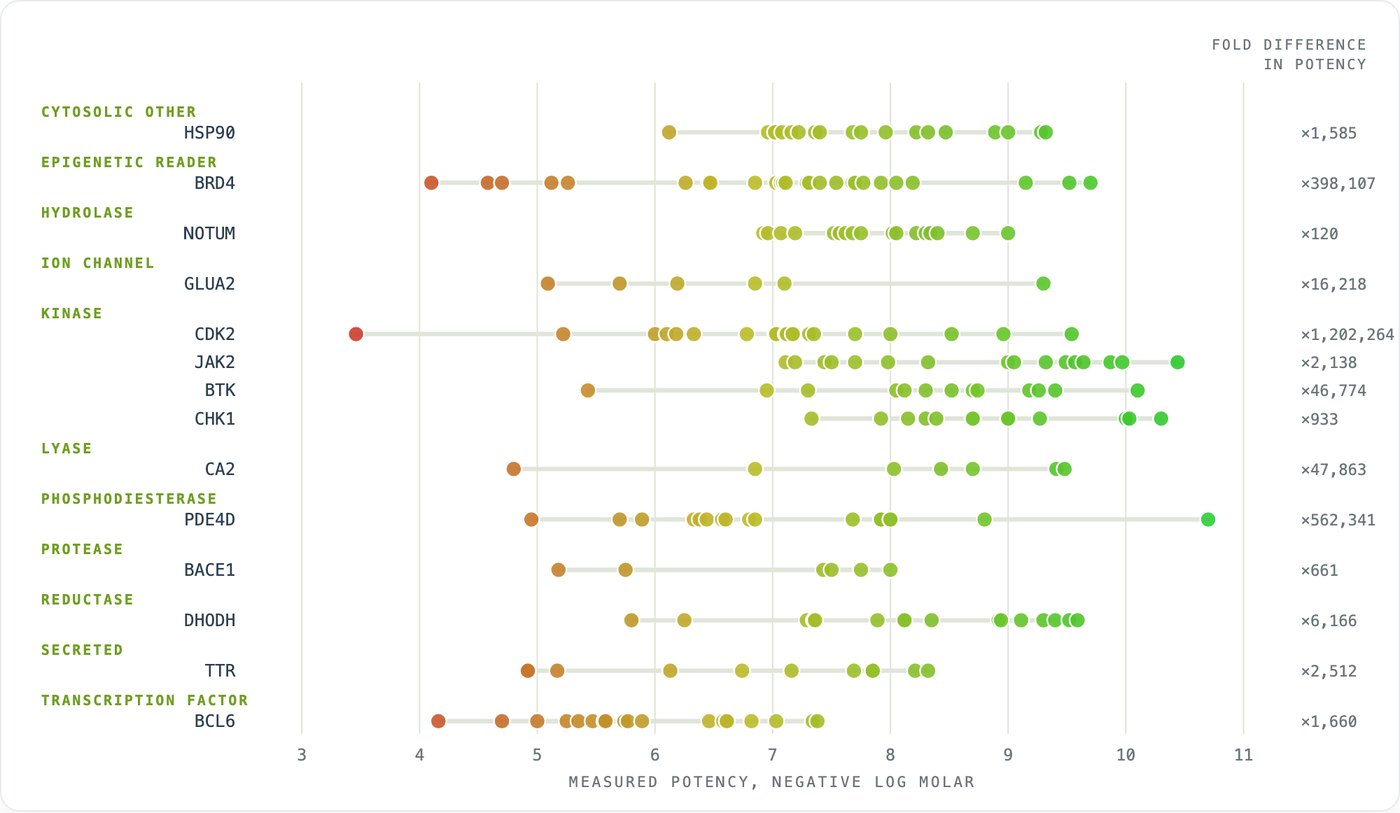
Comprehensive database for kinase research: 3.3M curated bioactivity data points across 579 kinase targets (Q2 2026 release)
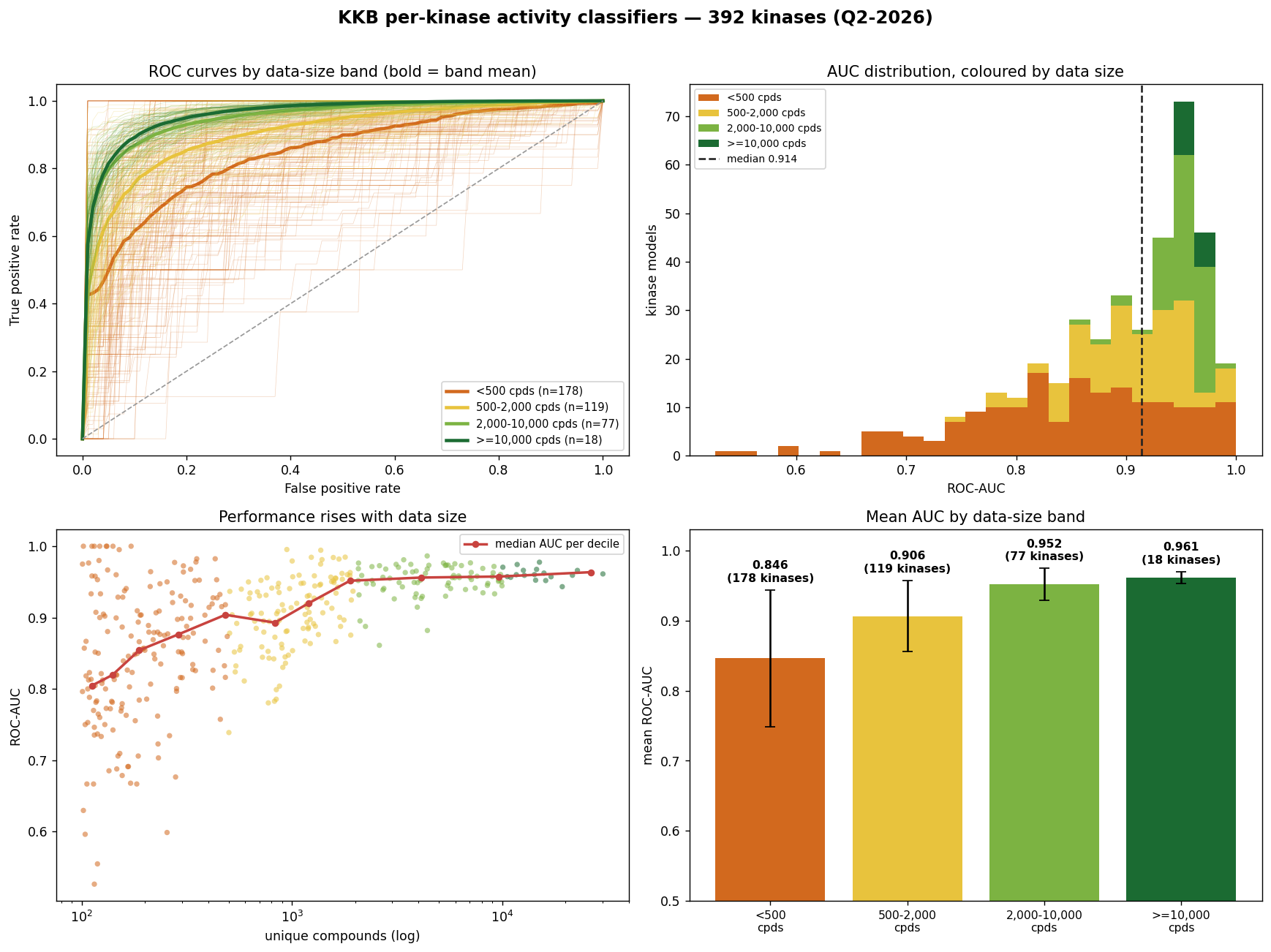
Per-kinase model performance across 392 kinases
To show what this depth of curation supports, we build machine-learning models from the KKB SAR and report how they perform: an activity classifier for each of 392 kinase targets and a potency regressor for 319 of them. Accuracy is highest for compounds chemically related to what a target already has in KKB and declines for novel scaffolds, so every prediction carries a similarity score against the model's own training set.
Model performance report →Explore KKB →
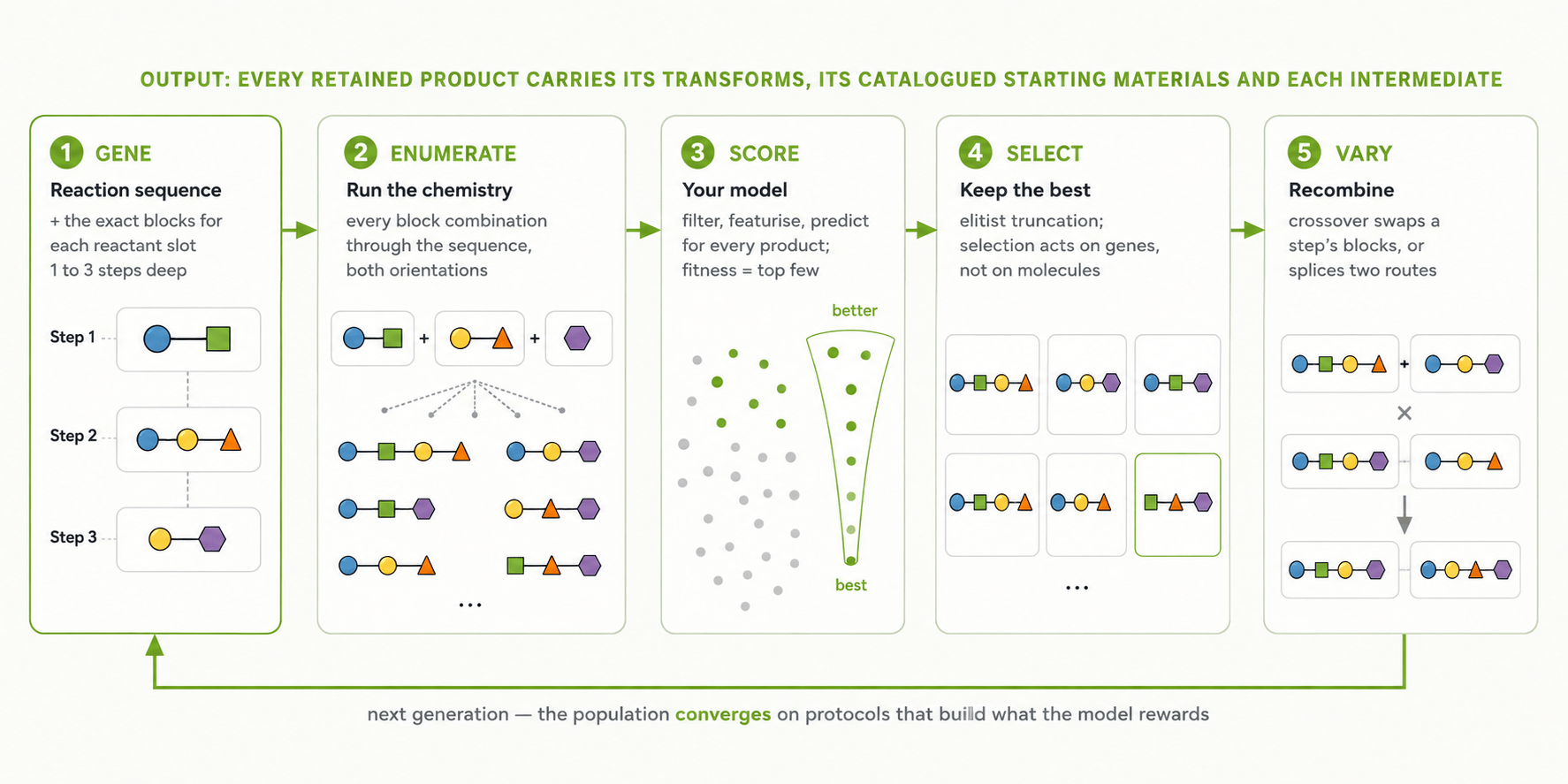
Swipe the diagram → · tap it for the full method
ChIP™ de Novo Design
Design molecules you can actually make. ChIP searches reaction space rather than molecule space: it evolves synthetic protocols from 85 validated reactions and 853,409 cataloged building blocks, scores what they produce with your own model, and returns every design with an executable synthesis from purchasable starting materials. Score on pharmacophore similarity instead and it designs the non-obvious “me-too”: high pharmacophore similarity, low 2D similarity.
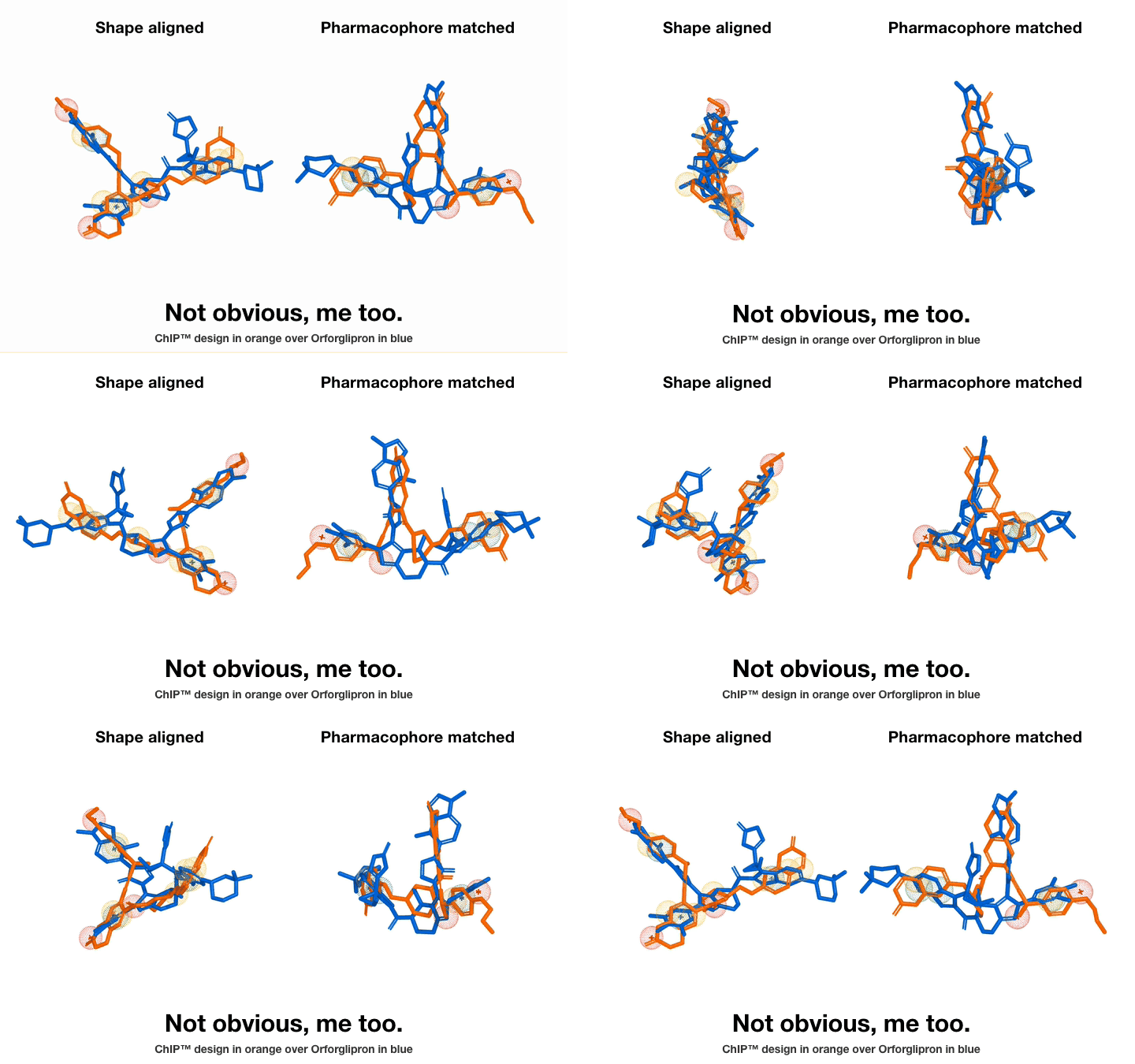
Swipe the card → · the ChIP design in orange over Orforglipron in blue, aligned two ways.
How ChIP works →Random forest potency example →
Non-obvious me too example →
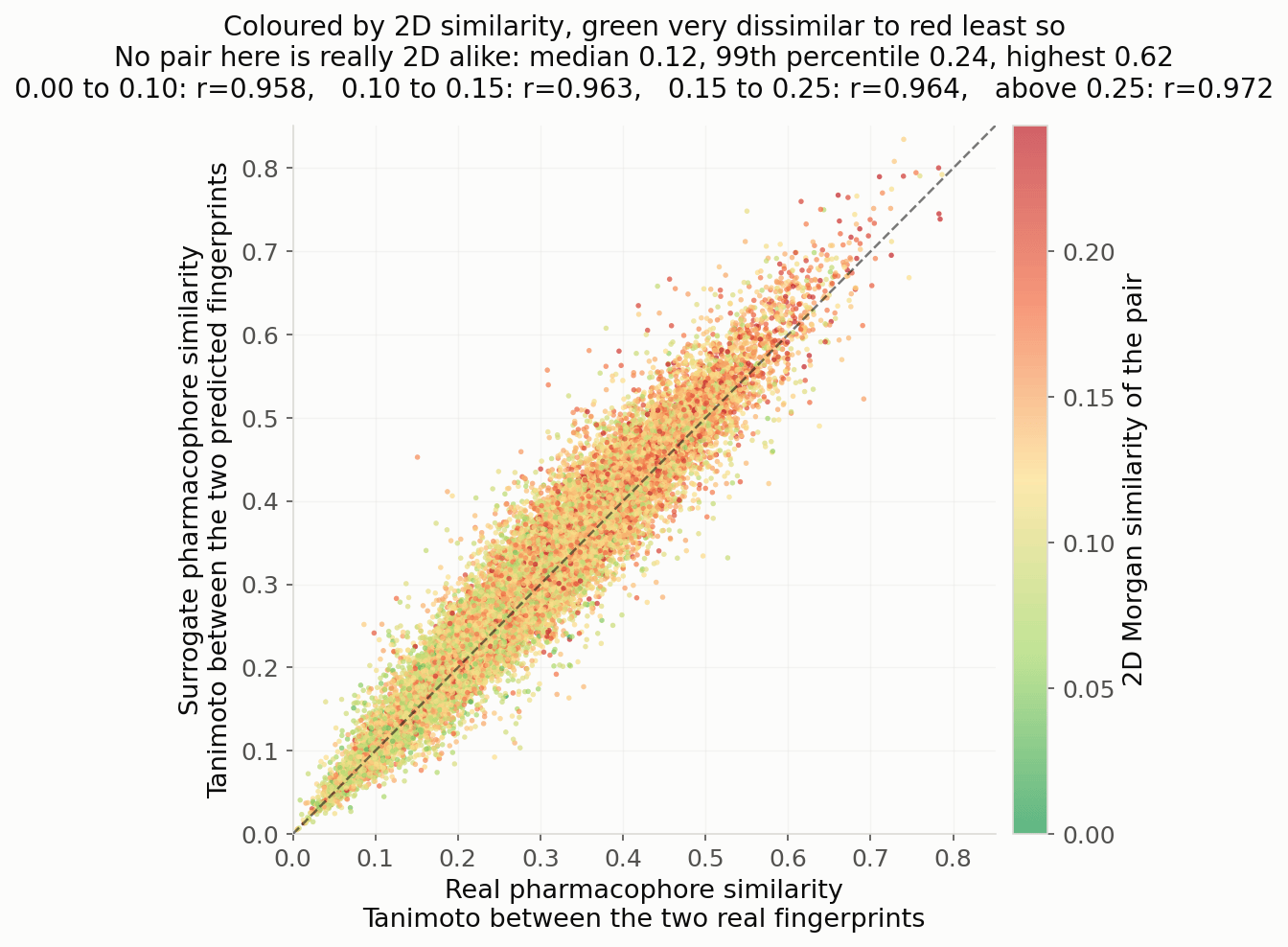
Turbocharged Pharmacophoric Similarity New!
PharmCast and PharmSim™. Compare, rank and cluster molecules by the three-dimensional features they present, from flat structure alone. The comparison is made on our pharmacophoric fingerprints, the 10,549-bit three-point PolyPharmPrint™ encoding. A full comparison of two molecules takes 0.584 milliseconds against 5.7 seconds for the real calculation, and agrees with it at Pearson 0.969. One reference against a million candidates drops from 33 days to 5 minutes. In a retrieval test the true nearest neighbor is in the surrogate's top 100 for 95.3% of queries.
How it works →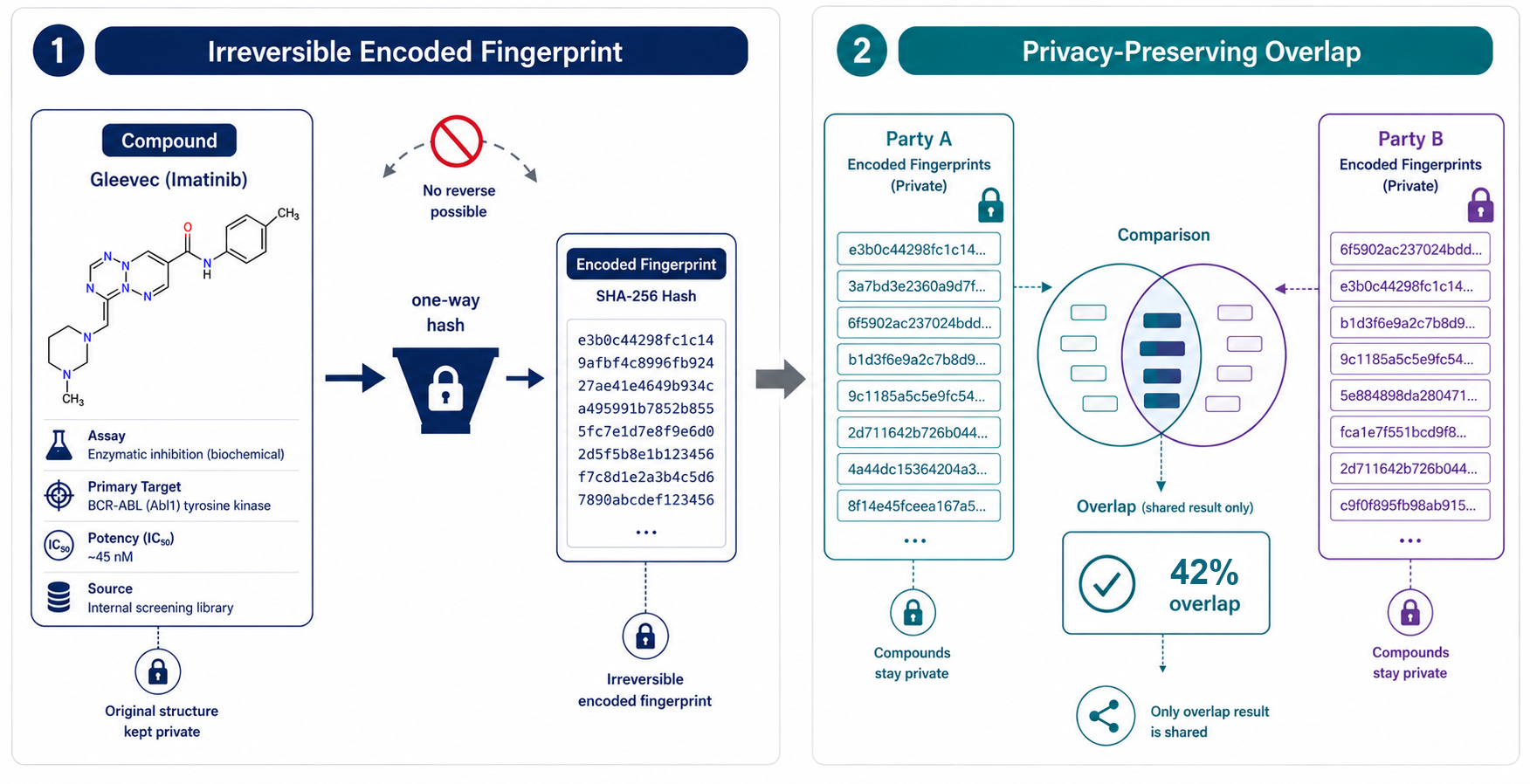
Illustrative example. Figures shown are for explanation only and are not results from our datasets.
Dataset Overlap Analysis New
How much of a dataset do you already have? Our toolkit answers that for any two SAR datasets, in any target family, without either side revealing a structure. Each party encodes its own data locally into irreversible SHA-256 fingerprints; only fingerprints are compared, and only the overlap figure is shared.
How it works →
Oncology Knowledgebase (OKB)
Targeted cancer therapeutics database with detailed compound information
Explore OKB →Model Performance
Activity classifiers: 392 kinases
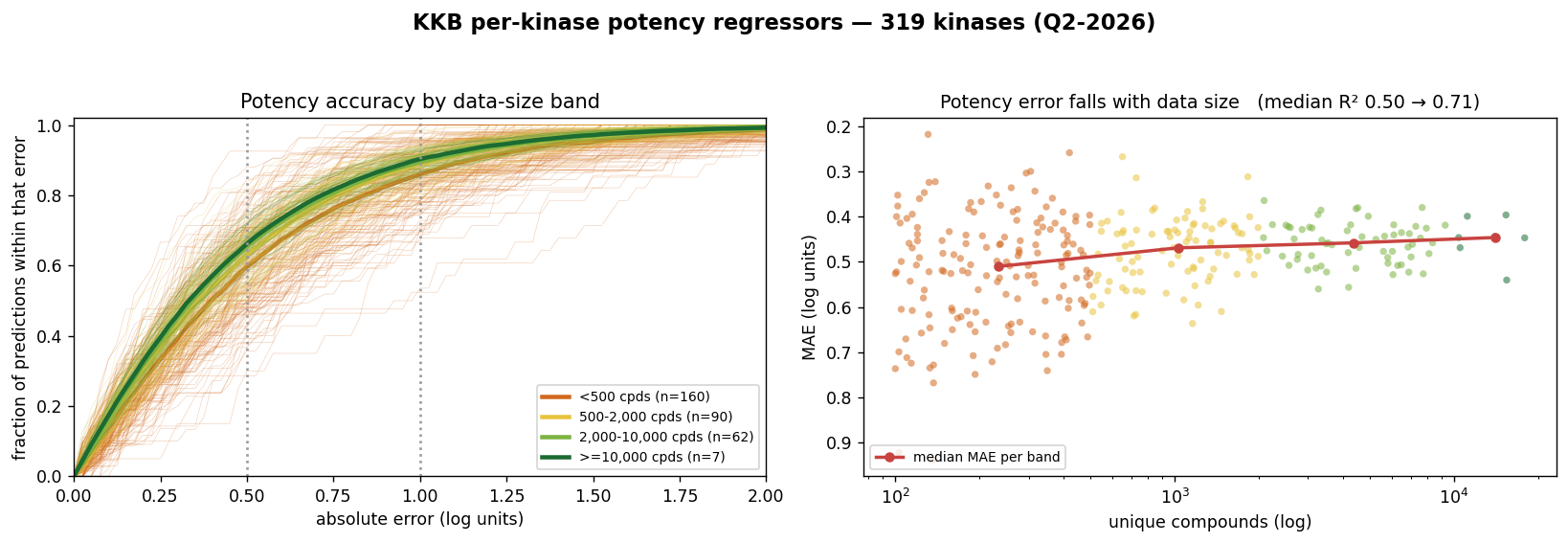 Potency regressors: 319 kinases
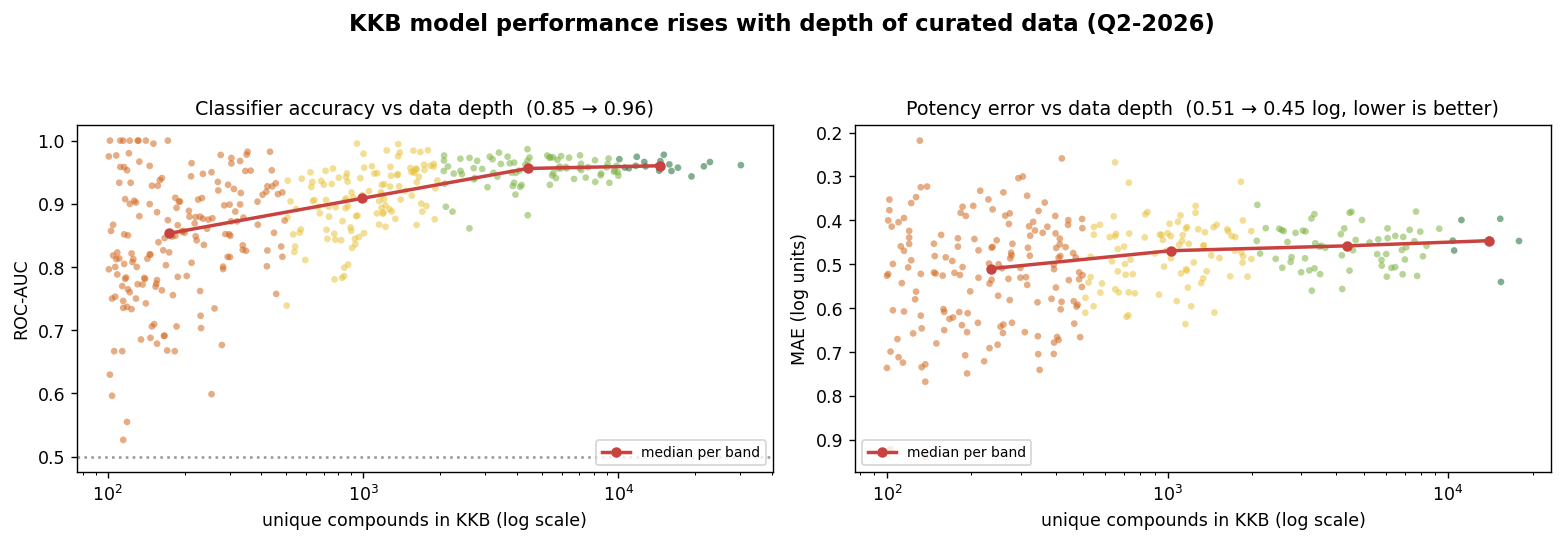 Performance vs depth of curated data
GPCR Foundation Model
Kinase Foundation Model, version 2
Performance vs depth of curated data
GPCR Foundation Model
Kinase Foundation Model, version 2
Swipe for more · tap a figure for the full report
Quick Links
Ready to accelerate your research?
Contact our team to learn more about our solutions