
Foundation Models
Models that rank, rather than score
Prioritization is a sequence of comparisons. Which of these two compounds should I make first, and which of these two proteins will it hit. These models answer those questions directly instead of predicting a value and asking you to subtract two predictions, each with its own error.
Every answer is a preference. The same two layouts work on any protein family with sequences and measured activity, and they are live across 34 families at once, and for G protein-coupled receptors and kinases in depth.
Two preferences, two layouts
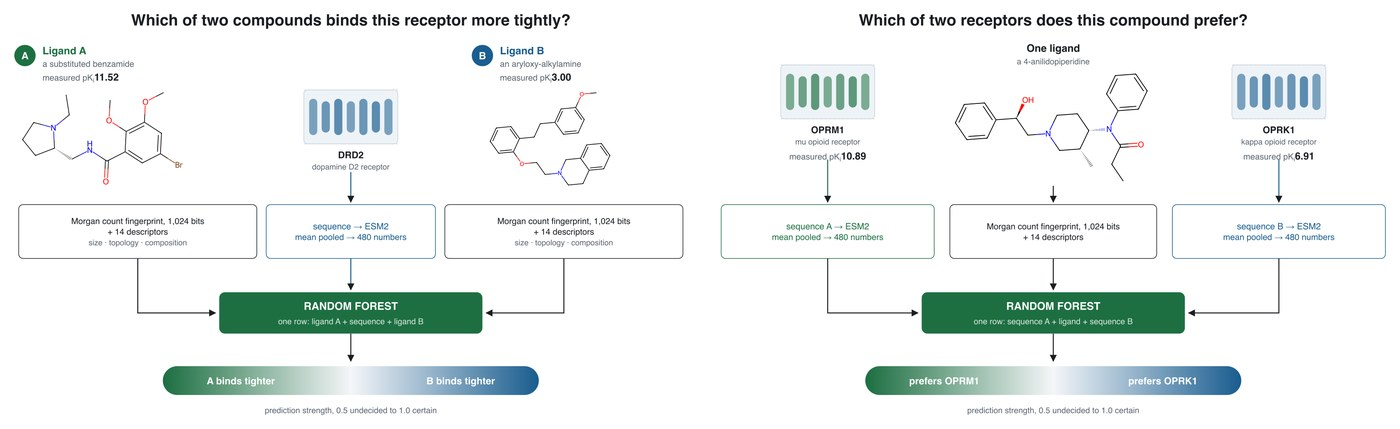
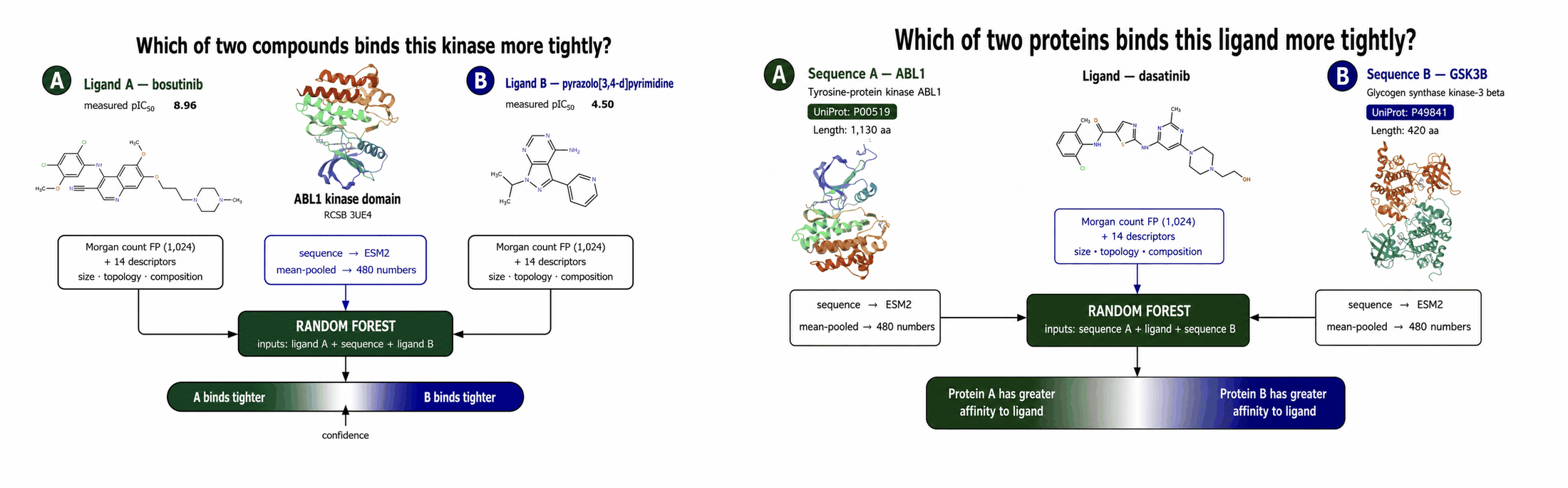
Both questions are about preference, and they differ in whose preference is being asked about. Each model takes one row; the order of that row is the question.
Compound preference “LSL”
One target, two compounds: which compound that target prefers. Used to order a set of molecules against a target you care about.
Target preference “SLS”
One compound, two targets: which target that compound prefers. Used to ask what else a molecule is likely to engage.
A compound becomes a Morgan count fingerprint with a short descriptor tail. A protein becomes a mean-pooled ESM2 embedding of its amino acid sequence. Nothing is docked, no structure is needed, and no binding site has to be defined. Every comparison is entered twice with the two outer blocks exchanged and the label inverted, so no answer depends on which side a compound was written on.
Every answer is an ordering with one number attached, its prediction strength, from 0.5 to 1.0. The strength is its own confidence: the further it sits from 0.5, the more often the ordering turns out right, and each site publishes the measured accuracy of every strength band.
The three families

Family Foundation Model
The broad instrument. Two separately fitted models over one roster that spans 34 protein families, trained on ChEMBL 37 alone, so both sets of weights are freely downloadable.
Compound preference “LSL”
One target held fixed, two compounds: which compound that target prefers.
| Accuracy, held out | 0.71 on 65,725 |
| At strength 0.80 and above | 0.96 on 3,995 |
| Targets it can score | 2,079 |
Target preference “SLS”
One compound held fixed, two targets from different families: which target that compound prefers.
| Accuracy, held out | 0.75 on 8,689 |
| At strength 0.80 and above | 0.93 on 3,119 |
| Targets it can score | 1,879 |
Models built 13 September 2026, on ChEMBL 37 alone.
familyfoundationmodel.com download the models code on GitHub watch the overview limitations
Two ways to build one of these. The cross-family models take breadth: 34 families in two separately fitted models, from ChEMBL 37 alone. The GPCR and kinase models take depth: one family each, on data assembled for it. Use a deep dive when every target of interest sits in its family; use the cross-family models when the comparison itself crosses the boundary.
GPCR Foundation Model
A deep dive into one family. Human G protein-coupled receptors, built on ChEMBL together with Eidogen-curated GPCR data, across IC50, Ki, Kd, EC50 and Kb.
| Potency, held out | 0.77 on 762,493 |
| Potency at strength 0.70 and above | 0.94 |
| Selectivity, held out | 0.80 on 24,741 |
| Selectivity at strength 0.70 and above | 0.93 |
| Proteins in the training data | 284 |
| With a held-out potency accuracy | 235 |
| With a held-out selectivity accuracy | 211 |
Models built 12 September 2026.
Kinase Foundation Model
The other deep dive. Protein kinases, with primary measurements from the Kinase Knowledgebase, our own curated collection, and ChEMBL used to cross-validate rather than to train.
| Potency, held out | 0.69 |
| Potency at strength 0.70 and above | 0.88 |
| Selectivity, held out | 0.75 |
| Selectivity at strength 0.70 and above | 0.92 |
| Kinases in the held-out set | 477 |
How to read a score
These are comparators: each answer is an ordering of the pair you gave it, carrying a strength whose measured accuracy every site publishes band by band. Per-protein accuracy varies, and closely related proteins are the hard case, which is exactly where a preference answer is most valuable. Every site publishes the per-protein figures rather than only the average, so a target can be checked before it is trusted.
Where the data comes from
The Family Foundation Model is trained on ChEMBL 37 alone. The kinase models are trained on the Kinase Knowledgebase, curated from the primary literature and patents since 2003. The GPCR models are trained on ChEMBL together with Eidogen-curated data: 389,013 measurements across 225,676 compounds and 284 proteins. Read each number against its own methods page rather than against another family, because each holdout is built its own way.
Related work: PharmCast predicts a three-dimensional pharmacophore fingerprint from a SMILES string, and Reverse Screen uses it to ask which proteins a molecule might hit.
Questions about a model?
Talk to the people who built it